




A Look at Florida Property Deeds
A house deed is more than a piece of paper. It is the legal document that transfers ownership and defines the exact rights you receive when you purchase property in Florida.
Because Florida has specific statutory requirements for deeds, understanding what yours says before closing can help you avoid costly title problems later on.

Let me explain what a Florida house deed looks like, how to read its key parts, and why a Fort Lauderdale real estate attorney can be an invaluable partner in protecting your investment.
What Is a Deed?
A deed is the written instrument used to transfer real property from one party to another. For a basic definition, see Hughes Real Estate Law’s glossary entry on a deed in real estate.
Under Florida law, a deed must identify the grantor and grantee, state the consideration, include a legal description of the property, be signed by the grantor in front of two witnesses, and be properly notarized.
Once delivered and accepted, the deed conveys legal title to the property. Recording the deed in the public records gives notice to the world and helps protect the buyer’s ownership rights.
Deeds establish ownership, provide a written record of the transaction, protect the buyer’s rights, and help maintain a clear chain of title, which is critical if you later refinance or sell the property.
Because Florida’s deed formalities are strict, even small drafting errors can cloud title. Many homeowners, buyers, sellers, and investors ask a real estate attorney or title professional to prepare or review the deed before closing.
What Does a Deed Look Like in Florida?
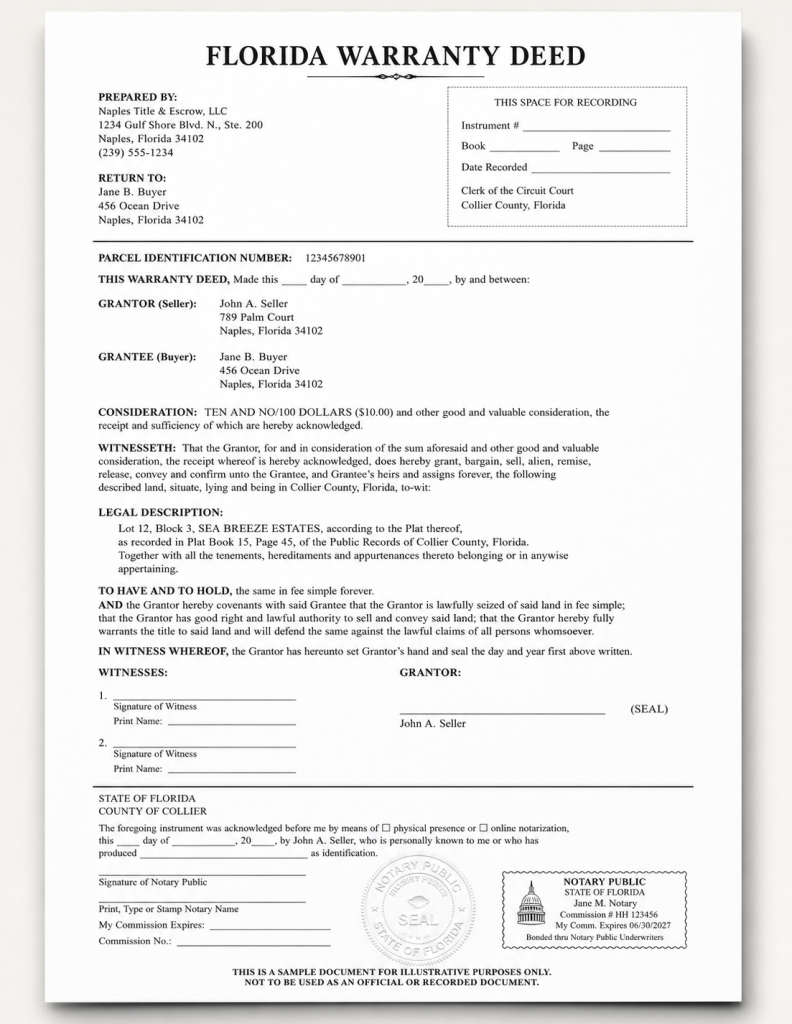
Although wording and formatting vary, most Florida deeds follow a similar structure. If you are buying property in Fort Lauderdale, Broward County, or anywhere in Florida, understanding the main parts of a deed can help you spot potential problems before they become expensive title issues.
A Florida deed will typically include the names of the parties, the type of deed being used, the legal description of the property, the consideration exchanged, the required signatures, witness information, a notary block, and recording information.
Types of Deeds in Florida
Different deed forms provide different levels of protection to the buyer. Choosing the right one can be critical to your ownership rights.
The three most common types of deeds used in Florida residential real estate transactions are:
- General Warranty Deed: Offers the broadest protection because the seller warrants that they hold clear title and agrees to defend the buyer against covered title claims, including claims that may have arisen before the seller acquired the property.
- Special Warranty Deed: Provides warranties only for the period during which the seller owned the property. It does not cover title defects that originated before the seller’s ownership.
- Quitclaim Deed: Transfers whatever interest the grantor may have in the property but gives no warranties about the quality of title. Quitclaim deeds are often used between family members or to correct title defects rather than for traditional arm’s-length purchases.
For a deeper dive into these and other deed types, see the firm’s FAQ on types of property deeds in Florida or its article on different types of deeds.
Key Parts of a Florida Deed
Buyers should review each section of the deed carefully before closing. Key elements typically include:
- Grantor and Grantee: The deed should correctly list the seller’s legal name and the buyer’s legal name. If there is more than one buyer, the deed should also reflect the intended form of co-ownership.
- Consideration: This identifies the value exchanged for the property. Deeds often state the purchase price or use language such as a nominal dollar amount plus “other valuable consideration.”
- Legal Description: This is the precise description of the property using metes and bounds, lot and block, or a government survey reference. A valid legal description is essential for a valid conveyance.
- Parcel Identification Number: Florida deed forms commonly include a space for the property appraiser’s parcel identification number, which helps the county index the deed. The parcel number helps identify the property, but the legal description controls.
- Warranties and Covenants: The deed language will show whether the grantor is giving general warranties, limited warranties tied to the grantor’s ownership, or no warranties at all.
- Execution, Witnesses, and Notary: The grantor must sign the deed in the presence of two witnesses, and the deed should include a complete notary block and printed names under each signature.
- Delivery and Acceptance: A deed must be delivered to and accepted by the grantee to complete the transfer.
Deeds may also reference easements, deed restrictions, homeowners’ association covenants, or other encumbrances. Buyers should read the entire document or have a real estate lawyer review it for any limitations that could affect how they use the property.
How to Read Your Deed Before Closing
Before signing at the closing table, review your deed line by line against your contract, survey, and title documents.
A practical approach is to use the deed as a checklist:
- Compare Names and Parties: Confirm that the grantor and grantee names match the purchase contract and that all intended owners are included in the correct capacity.
- Verify Consideration: Make sure the consideration reflects the agreed purchase price or correctly indicates that the transfer is a gift or nominal consideration transfer.
- Scrutinize the Legal Description: Cross-check the legal description on the deed with the survey, title commitment, and recorded plat to confirm the property being conveyed matches the property you intend to buy.
- Check Parcel Information: Make sure the parcel identification number field is completed if available, while understanding that the legal description remains the controlling property identifier.
- Read the Warranties: Confirm whether you are receiving a general warranty deed, special warranty deed, or quitclaim deed, and make sure that matches your expectations under the contract.
- Confirm Execution Formalities: Look for the grantor’s signature, two witness signatures, printed names, and a complete notary block.
- Note Restrictions and Encumbrances: Identify any references to easements, HOA covenants, deed restrictions, or recorded limitations that may affect improvements, parking, rental use, or future development.
If anything in the deed is unclear or inconsistent with the contract, buyers in Broward County should contact their closing attorney or a Fort Lauderdale real estate lawyer before closing rather than waiting until a title issue arises after the transfer.
How To Read a Legal Description
Why the Legal Description Matters
The legal description is one of the most important parts of a Florida deed because it precisely identifies the location and boundaries of the property being conveyed.
An inaccurate or incomplete legal description can lead to boundary disputes, encroachments, or title problems if the property cannot be properly identified from the description.
In Florida, three common systems are used:
- Metes and Bounds: Describes the property’s boundary lines using angles, directions, and distances. This is often used for irregular tracts or larger parcels.
- Lot and Block: Refers to a recorded subdivision plat using lot and block numbers along with the plat book and page. This is common in platted neighborhoods and condominium projects.
- Government Survey System: Uses township, range, and section numbers to describe property within a grid system, often for rural or larger tracts.
Buyers who plan to build, remodel, or add improvements often benefit from obtaining a current survey and confirming that the legal description on the deed matches the survey and county records through tools like the Broward County Property Appraiser website.
Recording Your Deed in Broward County
After closing, the deed is typically recorded with the Broward County Records, Taxes & Treasury Division so that it appears in the Official Records under the property owner’s name.
The recording process generally includes verifying that the deed meets recording requirements, calculating and paying any required documentary stamp taxes, and submitting the original deed and payment to the county for indexing in the Broward County Official Records system.
Although recording is not always required to make a properly executed deed valid between the parties, timely recording protects the new owner against many third-party claims and helps maintain an accurate chain of title for the property.
Buyers should confirm in their closing documents that the closing agent or attorney is responsible for recording the deed. They should also obtain a recorded copy or recording information once the deed posts to the county system.
Common Title Issues in Fort Lauderdale
In a fast-moving real estate market like Fort Lauderdale and greater Broward County, title searches frequently uncover issues that need to be resolved before or shortly after closing.
Examples of problems that may appear on title include:
- Boundary Disputes and Encroachments: Older surveys, fences built over the line, or improvements that cross lot lines can trigger disputes between neighbors in established neighborhoods.
- Title Defects: Unreleased mortgages, judgment liens, contractor liens, or unresolved probate issues can cloud title and may require curative deeds, releases, or court orders.
- Easement Conflicts: Utility easements, access easements, or association easements may limit where you can build or park and can affect future development plans.
- Chain of Title Problems: Missing documents, improper signatures, old transfers, or probate issues can complicate a future sale, refinance, or ownership dispute.
Working with a Broward County real estate law firm can help buyers identify and resolve these issues early, reducing the risk of later litigation or a failed resale.
Florida Deed and Recording Resources
The following resources may be helpful when reviewing a Florida deed or researching a Broward County property:
- Broward County Property Appraiser — Search property records, parcel identification numbers, property tax information, and certain assessment and exemption details.
- Broward County Clerk of Courts — Access court information and links related to official records and recorded instruments.
- Broward County Official Records Search — Search and view recorded deeds and other documents, and obtain unofficial or certified copies.
- Fort Lauderdale Building Services — Find building, permitting, and property improvement information for Fort Lauderdale properties.
- Florida Statute § 689.02 — Prescribed form of a warranty deed and related requirements.
- Florida Statutes Chapter 695 — Recording requirements and related provisions for official records.
- Florida Statutes Chapter 689 — General provisions related to conveyances of land and deed formalities.
For more background on how deed language fits into broader real estate disputes, readers can also review Hughes Real Estate Law’s information on real estate disputes and litigation in Fort Lauderdale.
Frequently Asked Questions About Florida Deeds
| Question | Answer |
|---|---|
| What is a deed? | A deed is a legal document that conveys ownership of real property from one party to another. |
| How is a deed different from title? | A deed is the document that transfers ownership. Title refers to the legal right to own, use, and transfer the property. |
| What does a Florida house deed usually include? | A Florida house deed usually includes the names of the grantor and grantee, the type of deed, consideration, legal description, parcel information, required signatures, witness signatures, a notary block, and recording information. |
| What happens if my deed is not recorded? | An unrecorded deed may still be valid between the parties, but it does not provide public notice and may leave the buyer vulnerable to later claims or title complications. |
| Can I prepare my own deed in Florida? | While some people attempt to prepare their own deeds, mistakes can create serious title problems. It is wise to have a deed reviewed by a real estate attorney or qualified title professional before it is signed and recorded. |
| Why is the legal description so important? | The legal description identifies the exact property being transferred. If it is inaccurate or incomplete, the deed may create boundary disputes, title issues, or problems when selling or refinancing the property later. |
Need Help Reading or Drafting a Deed?
Reading a Florida deed is not always straightforward. A single missed line can affect ownership rights, create a cloud on title, or complicate a future sale or refinance.
At Hughes Real Estate Law, Fort Lauderdale real estate attorney Joseph Hughes represents buyers, sellers, investors, landlords, and other property owners in transactions, title reviews, and real estate disputes throughout Broward County.
The firm assists clients with drafting and reviewing deeds, conducting title searches, resolving clouds and defects, and navigating the closing process for residential and commercial properties.
Contact Hughes Real Estate Law
Hughes Real Estate Law
1141 SE 2nd Ave
Fort Lauderdale, FL 33316
Phone: (954) 256-5125
Website: jhugheslegal.com
To schedule a consultation, visit the contact page or call the office to speak with a member of the team about your upcoming closing or deed questions.
Before you sit down at the closing table, take time to review your deed, confirm that all key elements are accurate, and consider consulting a Fort Lauderdale real estate attorney so your ownership is clear and secure from day one.
