




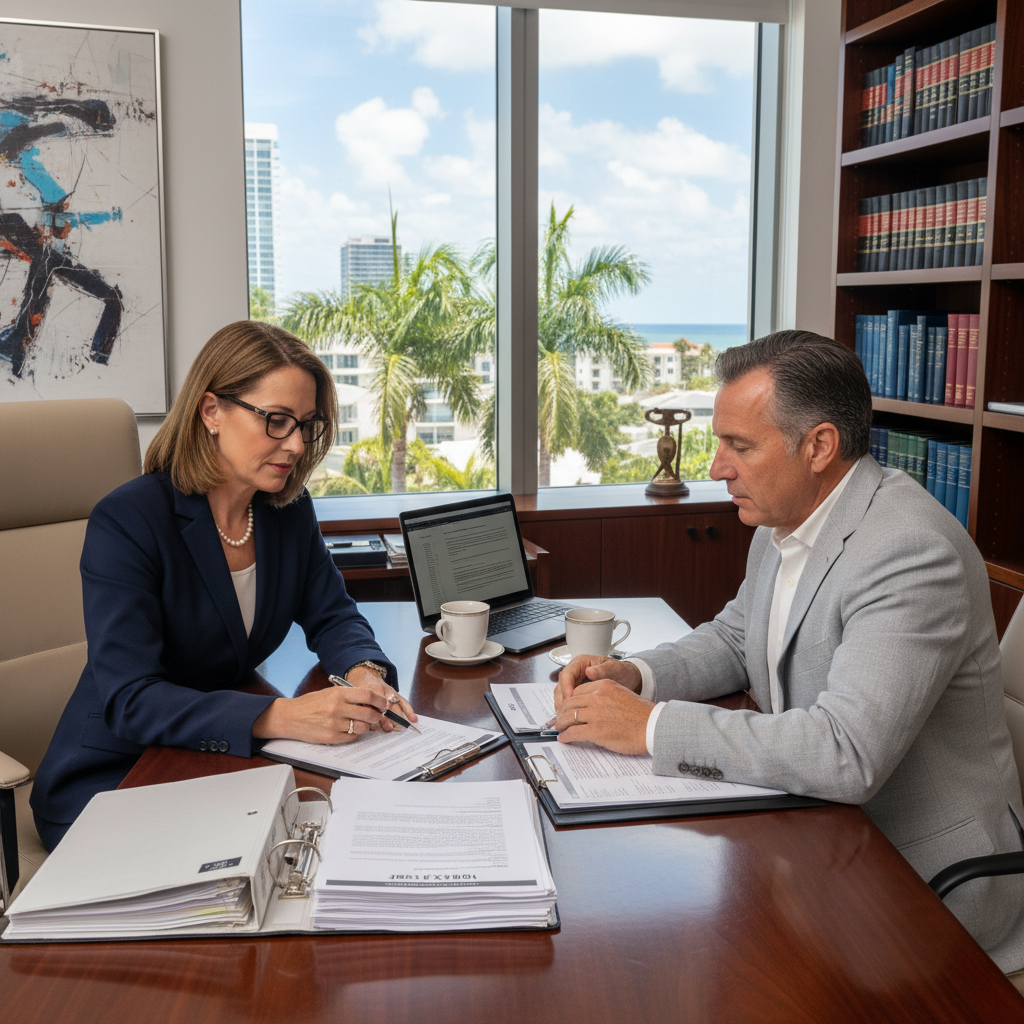
A 1031 exchange attorney in Fort Lauderdale helps real estate investors defer capital gains taxes by reinvesting proceeds from a property sale into a like-kind replacement property — using one of the most powerful wealth-building tools in the U.S. tax code. Named for Section 1031 of the Internal Revenue Code, a properly structured exchange allows investors to roll their entire equity — including what would have been lost to capital gains taxes — into the next investment. Done correctly, a 1031 exchange can be the difference between building a real estate portfolio and simply trading one property for another while the IRS takes a significant cut. Done incorrectly, it creates a taxable event, potential penalties, and the loss of the entire tax deferral benefit. A Fort Lauderdale 1031 exchange attorney ensures it is done correctly.
Joseph Hughes handles 1031 exchange transactions throughout Fort Lauderdale and Broward County for individual investors, LLCs, partnerships, and commercial property owners. Hughes Real Estate Law reviews exchange structures, coordinates with qualified intermediaries, advises on identification and closing deadlines, and ensures the relinquished and replacement property transactions satisfy IRS requirements. Joseph Hughes handles every 1031 exchange matter personally.
This page covers how a Florida 1031 exchange works, the critical deadlines that cannot be missed, common mistakes that disqualify exchanges, and how a Fort Lauderdale 1031 exchange attorney structures your transaction to protect the deferral.
How a 1031 Exchange Works in Florida
A 1031 exchange works by replacing one investment property with another — without the investor ever touching the sale proceeds. When the relinquished property closes, the proceeds go directly to a qualified intermediary (QI) — a third-party exchange facilitator who holds the funds. The investor then identifies a replacement property within 45 days and closes on it within 180 days. The QI delivers the proceeds to close the replacement property purchase. The investor never receives the money — and the IRS treats the transaction as a continuation of the original investment rather than a sale.
The key word is “properly structured.” Any misstep — receiving the sale proceeds even briefly, missing the 45-day identification deadline, failing to close within 180 days, or using the exchange funds for personal expenses — disqualifies the exchange and triggers the full capital gains tax liability. A Fort Lauderdale 1031 exchange attorney structures the transaction from the start to ensure none of these disqualifying events occur. The IRS provides Publication 544 covering like-kind exchange rules in detail.
Critical 1031 Exchange Deadlines
| Deadline | Rule |
|---|---|
| 45-Day Identification Deadline | The investor must identify potential replacement properties in writing within 45 days of the relinquished property closing. This deadline cannot be extended under any circumstances. |
| 180-Day Closing Deadline | The replacement property must close within 180 days of the relinquished property closing — or by the investor’s tax filing deadline for that year, whichever is earlier. |
| 3-Property Rule | An investor can identify up to 3 replacement properties without restriction on value |
| 200% Rule | An investor can identify more than 3 properties if the total fair market value of all identified properties does not exceed 200% of the relinquished property’s value |
| 95% Rule | An investor can identify any number of properties if they close on 95% of the total identified value |
What Qualifies as Like-Kind Property in Florida
“Like-kind” is broader than most investors realize. In a Florida 1031 exchange, virtually any real property held for investment or business use qualifies — a single-family rental can be exchanged for a commercial building, a vacant land parcel can be exchanged for an apartment complex, and a Fort Lauderdale condo investment can be exchanged for a shopping center in another state. The “like-kind” requirement refers to the nature of the asset — real property — not its specific type or location within the United States.
What does not qualify: personal residences, property held primarily for sale (dealer property), and property outside the United States. A Fort Lauderdale 1031 exchange attorney evaluates your specific relinquished and replacement properties at the outset — confirming qualification before the exchange structure is committed to. For related commercial transaction services, see commercial real estate attorney Fort Lauderdale. The existing overview of exchange rules is also covered in our 1031 exchange Florida rules page.
Common 1031 Exchange Mistakes That Disqualify the Exchange
- Receiving “boot” — Any cash or non-like-kind property received in the exchange is taxable as “boot.” A 1031 exchange attorney structures the transaction to minimize or eliminate boot
- Missing the 45-day deadline — No extension is available. Investors who miss this deadline lose the entire deferral benefit
- Using a non-qualified intermediary — Using a related party as the QI disqualifies the exchange. Your attorney coordinates with a properly independent qualified intermediary
- Receiving the proceeds directly — Even briefly receiving the sale proceeds before the QI does disqualifies the exchange entirely
- Exchanging into a property with a different title structure — The taxpayer who sells must be the same entity that buys. An LLC cannot sell and have its individual members buy as individuals
- Failing to reinvest the full amount — Any proceeds not reinvested in the replacement property are taxable as boot in the year of the exchange
For related closing and transaction services that support 1031 exchange closings, see real estate closing attorney Fort Lauderdale and purchase and sale agreements Fort Lauderdale. The IRS like-kind exchange resources provide additional guidance on exchange qualification requirements.
Local Resources for Fort Lauderdale 1031 Exchange Investors
| Resource | What It Provides | Link |
|---|---|---|
| IRS — Publication 544 | Official IRS guidance on like-kind exchanges and Section 1031 rules | irs.gov |
| Broward County Property Appraiser | Property records and values for Fort Lauderdale relinquished and replacement properties | bcpa.net |
| Broward County Clerk of Courts | Deed recordings for exchange closings | browardclerk.org |
| Florida Bar Consumer Resources | Legal guidance on real estate investment structures in Florida | floridabar.org |
Frequently Asked Questions
| Question | Answer |
|---|---|
| Can I do a 1031 exchange on a Florida rental property? | Yes — any property held for investment or business use qualifies, including single-family rentals, multi-family buildings, commercial properties, and vacant land held for investment. |
| What happens if I miss the 45-day identification deadline? | The exchange is disqualified and the full capital gains tax is owed on the sale. This deadline is absolute — no extensions are available. Contact a Fort Lauderdale 1031 exchange attorney immediately when a sale is pending. |
| Can I use a 1031 exchange to buy a vacation home? | Only under specific conditions. The IRS has rules governing exchanges into properties that will eventually be used personally. A 1031 exchange attorney advises on the holding period and use requirements to qualify. |
| Do I need a qualified intermediary for every 1031 exchange? | Yes — a QI is required for all deferred exchanges. The QI must be independent and must hold the proceeds between the relinquished and replacement property closings. Your attorney coordinates QI selection as part of the exchange setup. |
| Does Joseph Hughes handle 1031 exchanges involving commercial properties? | Yes. Hughes Real Estate Law handles 1031 exchange transactions for residential and commercial investment properties throughout Fort Lauderdale and Broward County. |
Defer the Tax. Keep the Equity. Build the Portfolio.
Hughes Real Estate Law handles 1031 exchange transactions in Fort Lauderdale for investors throughout Broward County. Call (954) 256-5125 or visit our contact page to schedule your consultation today.
About Hughes Real Estate Law
Hughes Real Estate Law is a Fort Lauderdale real estate law firm focused exclusively on Florida property law. Joseph Hughes handles 1031 exchange transactions, commercial acquisitions, and investment property closings for investors throughout Broward County. The firm serves Fort Lauderdale, Hollywood, Pompano Beach, Davie, Coral Springs, Dania Beach, Wilton Manors, Oakland Park, Sunrise, and Margate. Call (954) 256-5125 to speak with a Fort Lauderdale 1031 exchange attorney directly.