




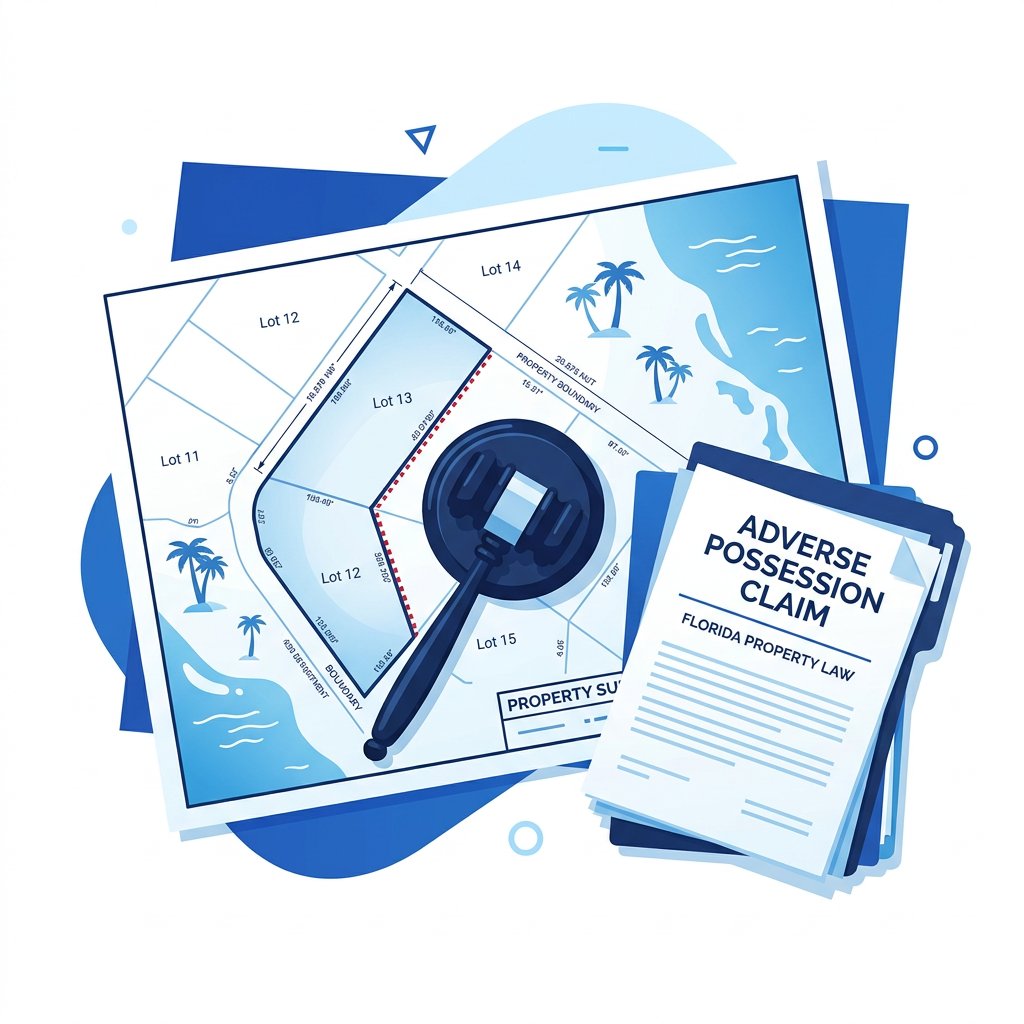
Adverse Possession Florida: How Someone Can Legally Claim Your Property
Adverse possession Florida is a legal doctrine that allows a person to claim ownership of land they do not hold title to. Under Florida Statute §95.18, a claimant must occupy the property openly, continuously, and without the owner’s permission for at least seven years. If all legal elements are met, a court may transfer title from the original owner to the occupier. Florida homeowners who discover an encroachment or unauthorized use of their land need to act fast. Delay can cost you your property — permanently.
What Is Adverse Possession Under Florida Law?
Adverse possession Florida is rooted in the idea that land should be used productively. Florida courts do not reward absentee ownership when someone else has been openly maintaining and occupying the property for years. The doctrine traces back to English common law and is now codified in Florida Statute §95.18.
There are two types of adverse possession claims in Florida. The first applies when the claimant has color of title — meaning a written document, even a defective one, that purports to convey ownership. The second applies without color of title, where the claim rests entirely on years of open and continuous possession.
In both cases, the seven-year clock does not start until every required element is present. One missing element resets the timeline entirely. That is why working with a real estate attorney in Fort Lauderdale early gives property owners the best chance of defending their land.
The Five Legal Elements of Adverse Possession in Florida
Florida courts require every element to be proven by clear and convincing evidence. To succeed, a claimant must show all five of the following:
- Actual possession — physical use or occupation of the land
- Open and notorious — the use is visible and obvious to any observer
- Hostile — occupation occurs without the owner’s permission
- Exclusive — the claimant is not sharing possession with the true owner
- Continuous for seven years — uninterrupted possession throughout the statutory period
If any one of these elements is missing, the adverse possession Florida claim fails. A property owner who gives verbal permission — even casually — effectively resets the hostility element and defeats the claim entirely. This is one of the most practical and immediate defenses available.
Florida Statute §95.18: The Rule That Governs Adverse Possession
Florida Statute §95.18 is the controlling law for adverse possession Florida claims without color of title. The statute imposes an additional requirement that most other states do not: the claimant must file a return with the county property appraiser. This filing must include a full legal description of the property being claimed.
This requirement was added in 2011 to reduce fraudulent adverse possession claims. Before the change, squatters could quietly occupy vacant homes and later claim ownership. The property appraiser filing creates a public record and puts the true owner on notice. If the claimant fails to file, the seven-year clock does not run — regardless of how long they have been in possession.
Florida courts have consistently held that strict compliance with §95.18 is required. Partial filings or incorrect legal descriptions are not sufficient. According to Florida’s official statutes, the return must be filed before the seven-year period is complete.
Adverse Possession With Color of Title in Florida
Adverse possession Florida with color of title operates similarly but carries some distinct advantages for the claimant. Color of title means the person holds a written instrument — a deed, a court order, or even a will — that appears to convey ownership, even if it is legally defective.
With color of title, the claimant’s possession extends to the full boundaries described in the defective document — not just the portion physically occupied. This is significant when dealing with large parcels. A claimant who occupies only a portion of a lot but holds color of title may be able to claim the entire described area after seven years.
Courts look closely at whether the claimant genuinely believed the document was valid. Bad faith — knowing the title was fraudulent at the time of acquisition — can defeat a color of title claim. If you are facing this situation, a Fort Lauderdale real estate litigation lawyer can review the document and assess its legal weight.
How to Stop an Adverse Possession Florida Claim Against Your Property
The most effective way to defeat an adverse possession claim is to act before seven years pass. Florida property owners have several options to interrupt the statutory period and protect their title.
Give written permission. Granting a neighbor written permission to use a portion of your land destroys the hostility element. The possession is no longer adverse — it is licensed. Keep a copy of any permission letter in your records.
File a trespass or ejectment action. A formal legal action interrupts the statutory period and puts the claimant on notice that possession is contested. Even if the dispute seems minor, filing promptly protects your rights under Florida property line encroachment laws.
Monitor your property regularly. Owners who check their land frequently and address unauthorized use quickly are far less likely to face a successful claim. Courts are unsympathetic to owners who knew about encroachments and did nothing.
Record your title. Maintaining current title records and surveys through the Broward County Recording Office gives you a clear baseline to challenge any adverse claim.
What Happens After a Successful Adverse Possession Claim?
When a Florida court grants an adverse possession claim, the claimant receives a court judgment that serves as evidence of ownership. That judgment must be recorded in the public records of the county where the property is located. Once recorded, the claimant holds legal title — the same as any deed transfer.
The original owner loses all rights to the property at that point. There is no compensation and no appeal process once the judgment is final and recorded. This is why early intervention in any encroachment or unauthorized use situation is so important.
If you have discovered someone occupying or making improvements to your land, do not wait. Time works entirely in the claimant’s favor once the statutory period begins running. A real estate dispute attorney in Fort Lauderdale can evaluate the timeline and advise on immediate steps to protect your ownership.
Adverse Possession Florida vs. Easement: Understanding the Difference
Many homeowners confuse adverse possession in Florida with prescriptive easements. Both arise from long-term unauthorized use of another’s property. The difference is significant: adverse possession transfers full ownership, while a prescriptive easement grants only a right to use the land for a specific purpose.
A prescriptive easement requires the same elements as adverse possession — open, notorious, hostile, and continuous use — but the use must be limited in scope. A neighbor who regularly walks across your yard for twenty years may acquire a prescriptive easement to continue doing so. They do not acquire title to your yard.
Both claims can seriously affect your property rights. The Florida Bar Association recommends consulting a licensed real estate attorney any time a neighbor’s use of your land has been ongoing without a written agreement.
Real-World Scenarios: When Adverse Possession Comes Up in Florida
Adverse possession Florida claims arise most commonly in these situations:
- A neighbor’s fence is built several feet inside your property line and has been there for over seven years
- A vacant lot owner discovers a neighboring business has been using their land for parking for a decade
- An heir inherits land and finds a third party has been farming or maintaining it for years
- A buyer purchases property and later learns a portion is claimed by an adjacent owner through long-term occupation
In each of these cases, the outcome depends entirely on whether the legal elements were met and whether the true owner took timely action. If you are buying property in Fort Lauderdale or anywhere in South Florida, a title search and survey should always be conducted before closing. Your Florida real estate attorney can coordinate both and flag any potential adverse claims before they become your problem.
Protect Your Florida Property Before It’s Too Late
Understanding adverse possession Florida law is the first step — acting on it is what protects your title. At J Hughes Legal, we help Fort Lauderdale property owners identify, challenge, and defeat adverse possession claims before they reach a courtroom. Call us at (954) 256-5125 or visit our contact page to speak with a real estate attorney today.
About J Hughes Legal
J Hughes Legal is a Fort Lauderdale real estate law firm serving clients throughout South Florida, including Broward, Miami-Dade, and Palm Beach counties. Attorney Joseph Hughes focuses exclusively on real estate law — from property disputes and title issues to litigation and transactional matters. The firm handles both residential and commercial cases with direct partner attention from start to finish. Located at 1141 SE 2nd Ave, Fort Lauderdale, FL 33316, J Hughes Legal is available at (954) 256-5125.