




5 Construction Defects To Look Out For
When you’ve just closed on a Fort Lauderdale home, the last thing you expect is to discover that your walls are harboring mold, your foundation is cracking, or your electrical panel is a fire waiting to happen. Yet construction defects are among the most common — and most costly — problems Fort Lauderdale homeowners face after buying. Florida’s rapid development pace, high humidity, and hurricane exposure create conditions where construction shortcuts get buried behind drywall and fresh paint. Knowing what to look for, and understanding your rights under Florida law, can mean the difference between a costly repair you absorb alone and a legal recovery against those responsible.
What Counts as a Construction Defect Under Florida Law
Before you can act on a construction defect Fort Lauderdale claim, you need to understand what Florida law actually covers. Under Chapter 558 of the Florida Statutes, a construction defect includes any deficiency in design, workmanship, materials, or failure to comply with applicable building codes that causes physical damage to a structure, limits its habitability, or reduces its value. This definition is intentionally broad — it covers builders, general contractors, subcontractors, engineers, and architects.
Patent vs. Latent Defects
Patent defects are visible and discoverable during a reasonable inspection — cracked tile, a misaligned door frame, obvious water staining. Latent defects are hidden: moisture intrusion inside walls, corroding pipes inside slabs, improperly secured roof trusses. Latent defects are the most dangerous category because they may not surface until years after closing, often after warranties have expired. Florida’s statute of limitations for latent construction defects runs 4 years from the date of discovery, with a 10-year statute of repose from the date of construction completion under Florida Statute § 95.11(3)(c).
The Implied Warranty of Habitability
Florida courts recognize an implied warranty that newly constructed homes are built in a workmanlike manner and fit for habitation. This warranty runs with the property — meaning even a subsequent buyer (not just the original purchaser) may have standing to bring a claim. If you bought a home that was recently built or recently renovated, the construction defects warranty may protect you even if you weren’t the original owner who contracted with the builder.
Who Is Legally Responsible
Liability for construction defects in Fort Lauderdale can fall on the general contractor, licensed subcontractors, architects, engineers, material suppliers, and in some cases the developer or seller. Florida’s Florida Bar recognizes multiple theories of recovery including breach of contract, negligence, strict liability for defective products, and statutory violations. An experienced Fort Lauderdale construction defect attorney will identify every responsible party — not just the most obvious one.
Practical Rule: If a defect was present when you bought the home — whether you can see it or not — you may have a viable legal claim under Florida law. The clock doesn’t start running until you discover the defect, not when the home was built.
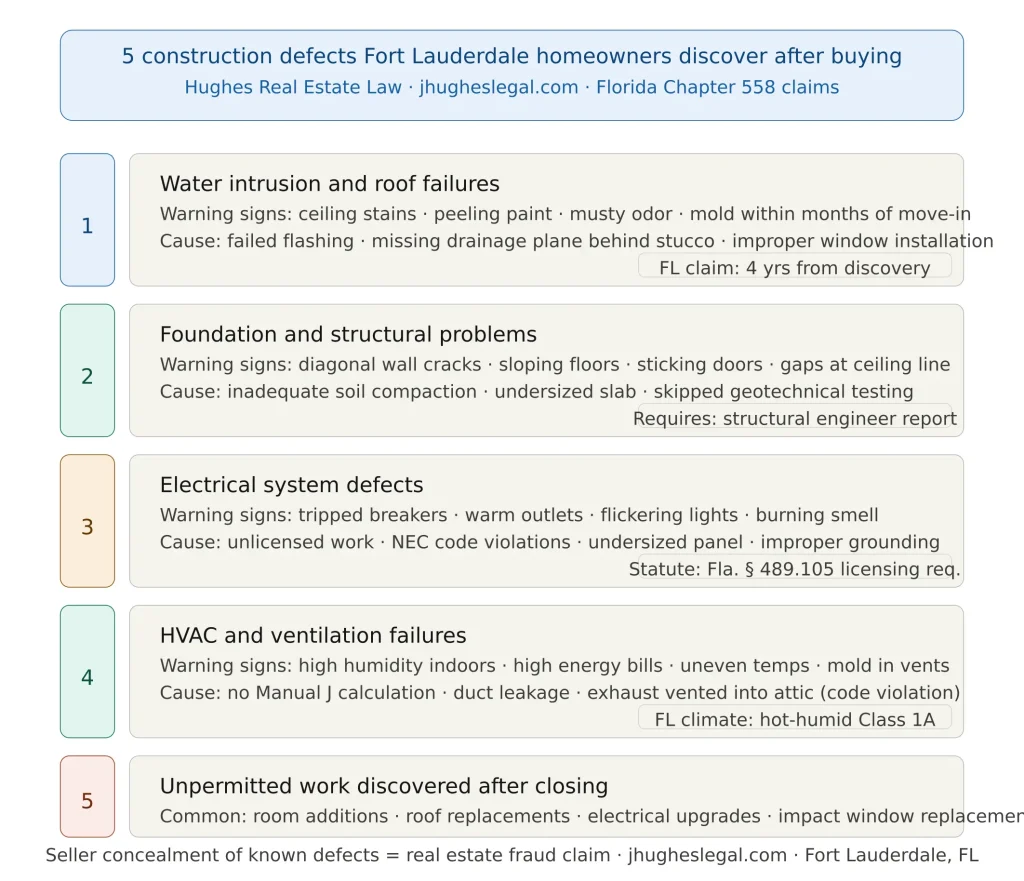
Defect #1 — Water Intrusion and Roof Failures
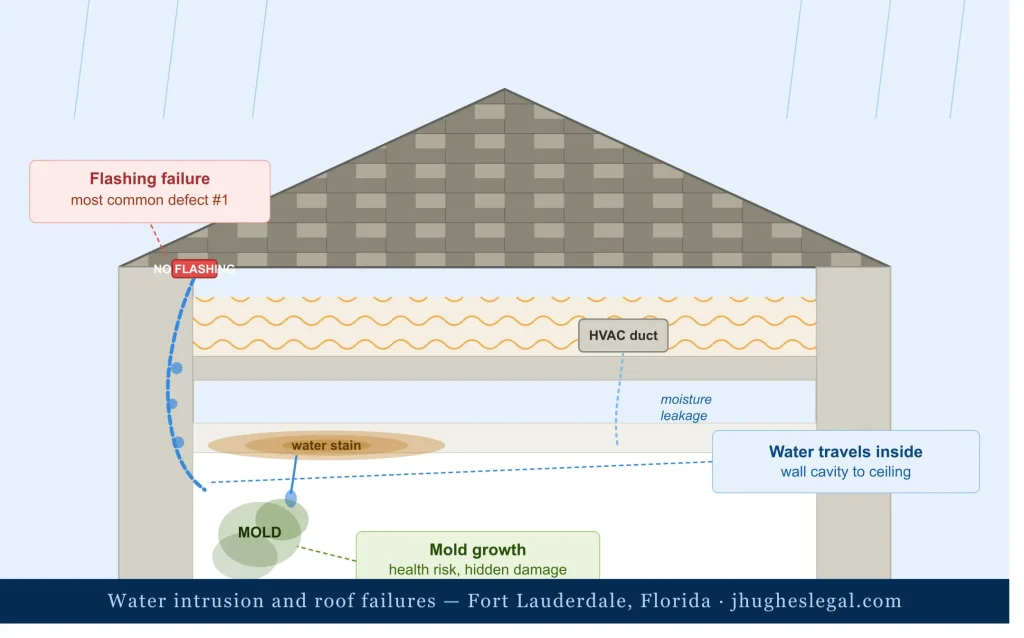
Water intrusion is the single most common construction defect Fort Lauderdale homeowners discover after buying, and it is also the most destructive over time. South Florida’s combination of intense rainfall, hurricane-force wind-driven rain, and extreme humidity creates relentless pressure on roofing systems, flashing, window seals, and exterior stucco. When any of these systems are improperly installed, water finds its way inside.
What It Looks Like
Water intrusion from construction defects typically presents as brown ceiling stains, bubbling or peeling interior paint, efflorescence on exterior walls, soft spots in drywall, warped baseboards, and a persistent musty odor that no amount of cleaning resolves. In severe cases, visible black mold growth appears on walls and ceilings within months of move-in.
Common Construction Failures Behind Water Intrusion
- Improper flashing: Roof-to-wall transitions, chimney surrounds, and skylight frames require metal flashing installed to code. Flashing shortcuts are among the most common causes of severe water damage.
- Stucco over moisture barriers: Fort Lauderdale homes clad in stucco require a properly installed drainage plane behind the stucco system. Missing or improperly installed barriers allow moisture to penetrate the wall assembly and reach the framing.
- Window and door installation defects: Windows installed without proper sill pan flashing or with inadequate sealant around frames allow wind-driven rain to enter at every storm.
- Roof deck fastening failures: Roof sheathing inadequately fastened to trusses can lift during high-wind events, allowing catastrophic water entry.
Legal Angle
Water intrusion claims are often complicated by insurance disputes over whether damage is a covered casualty event or the result of construction defects (which are generally excluded from standard homeowners policies). A Fort Lauderdale real estate litigation attorney can help you separate the construction liability claim from the insurance dispute and pursue both tracks simultaneously.
Practical Rule: If your roof, windows, or walls are letting in water within the first 5 years of a home’s construction, the cause is almost always a construction defect — not normal wear and tear. Document everything before making temporary repairs.
Defect #2 — Foundation and Structural Problems
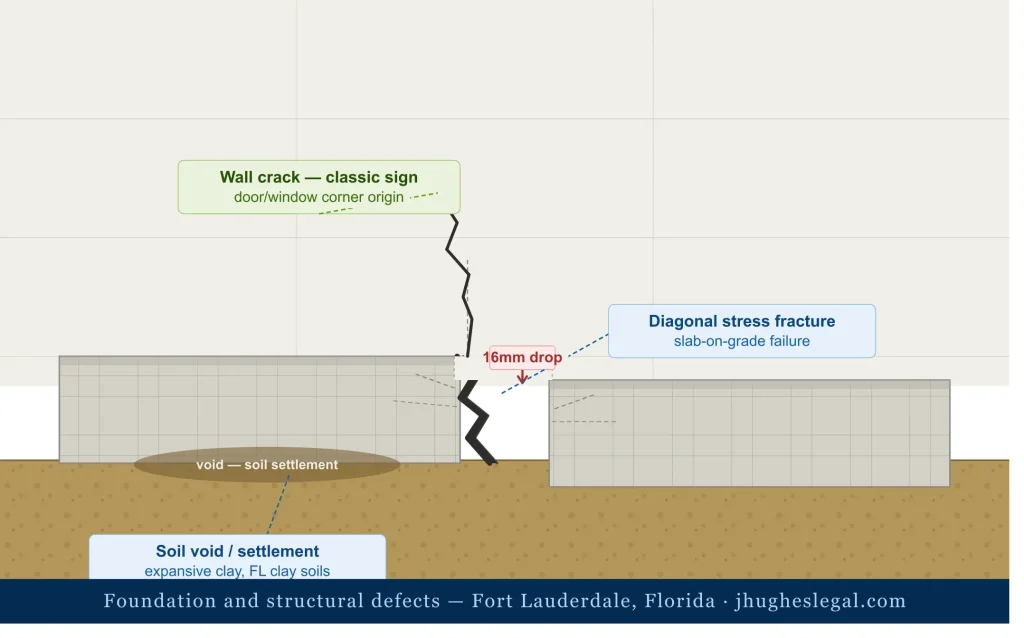
Foundation and structural construction defects are the most alarming category because they directly threaten the structural integrity of the home. In Fort Lauderdale and Broward County, expansive clay soils, high water tables, and the prevalence of slab-on-grade construction create a particularly challenging environment for foundations — one that shortcuts in site preparation, soil compaction, and concrete design can turn into a slow-motion disaster.
Warning Signs
- Diagonal cracks running from the corners of windows and door frames
- Horizontal cracks in exterior block or brick walls (a serious structural red flag)
- Floors that slope noticeably, especially in newer construction
- Doors and windows that stick, bind, or no longer close flush
- Gaps developing between walls and ceilings or between walls and floors
Root Causes
Structural defects in Fort Lauderdale homes typically trace to inadequate soil testing before construction, improper soil compaction, undersized or improperly reinforced concrete slabs, and failure to account for soil shrink-swell characteristics. When a builder skips or shortcuts geotechnical analysis to reduce costs, the home pays for it in foundation movement.
Engineering and Legal Documentation
Structural construction defect claims require a licensed structural engineer’s expert report to establish causation and quantify repair costs. This is not optional — Florida courts expect expert testimony in construction defect litigation. At Hughes Real Estate Law, we work with qualified forensic engineers in the Fort Lauderdale area to build airtight cases for homeowners facing structural failures.
Practical Rule: Any crack wider than 1/4 inch in a slab, foundation wall, or load-bearing wall warrants immediate evaluation by a structural engineer — not a contractor offering a patch job.
Quick Reference: Common Construction Defects, Warning Signs, and Florida Deadlines
| Defect Type | Warning Signs | Legal Claim Deadline (Florida) |
| Water intrusion / roof | Stains, mold, musty smell, peeling paint | 4 years from discovery (latent) |
| Foundation / structural | Cracks in walls, sloping floors, sticking doors | 4 years from discovery (latent) |
| Electrical systems | Flickering lights, tripped breakers, burning smell | 4 years from discovery (latent) |
| HVAC / ventilation | Uneven temps, high bills, moisture buildup | 4 years from discovery (latent) |
| Unpermitted work | No permit records, failed re-inspection | Runs from date of discovery |
Defect #3 — Electrical System Defects
Electrical construction defects are among the most dangerous because the consequences can be fatal. Faulty wiring, undersized panels, improper grounding, and code-violating installation practices are routinely found in Fort Lauderdale homes — particularly those built or renovated during high-demand periods when licensed electrical subcontractors were in short supply and unlicensed work filled the gap.
Signs of Electrical Construction Defects
- Circuit breakers that trip repeatedly under normal load
- Outlets that are warm to the touch, spark, or show scorch marks
- Flickering lights not explained by bulb issues or utility supply problems
- A burning or electrical smell with no identifiable source
- Two-prong ungrounded outlets throughout a home built after the applicable code requiring grounding
Unlicensed Electrical Work
Under Florida Statute § 489.105, electrical work above defined thresholds must be performed by a licensed electrical contractor. Unlicensed electrical work that passes through a closing — whether disclosed or not — is a significant source of liability. If the construction defect results from unlicensed work, you may have claims not only against the contractor but against any seller who knew and failed to disclose it.
Fort Lauderdale Building Code Violations
Broward County and the City of Fort Lauderdale enforce the Florida Building Code, which incorporates the National Electrical Code (NEC). Any installation that violates the NEC version in force at the time of construction is per se a construction defect. A licensed electrician performing a code compliance inspection — distinct from a home inspection — is the appropriate way to document these violations before litigation.
Practical Rule: Never assume electrical problems in a newer home are normal. Any code violation found in a post-purchase electrical inspection is potential evidence of a construction defect claim.
Defect #4 — HVAC and Ventilation Failures
In Fort Lauderdale’s climate, a properly designed and installed HVAC system isn’t a luxury — it’s essential to both comfort and the structural integrity of the home. Poorly designed or improperly installed HVAC systems create chronic moisture problems that accelerate mold growth, degrade air quality, and cause secondary construction defects throughout the building envelope.
Common HVAC Construction Defects
- Undersized systems: HVAC equipment sized by rule of thumb rather than Manual J load calculation is endemic in South Florida new construction. An undersized system runs continuously, struggles to dehumidify, and creates chronic high-humidity conditions inside the home that feed mold.
- Duct leakage: Ductwork installed without proper sealing at connections and joints bleeds conditioned air into unconditioned spaces, reducing efficiency and creating pressure imbalances that pull humid outdoor air into wall cavities.
- Missing or improper vapor barriers: In Fort Lauderdale’s hot-humid climate classification, vapor barriers on the wrong side of the wall assembly trap moisture inside the wall, directly causing rot and mold.
- Inadequate exhaust ventilation: Bathrooms, kitchens, and laundry rooms require mechanical exhaust to outside air. Systems that exhaust into attic spaces — a code violation — deposit moisture directly where it causes the most damage.
Proving HVAC Defects
HVAC construction defect claims typically require a licensed mechanical engineer to perform a Manual J calculation, duct blower door testing, and a full system commissioning review. The gap between what was installed and what code required becomes the foundation of the claim.
Practical Rule: If your Fort Lauderdale home feels humid even when the AC is running, or if your energy bills are dramatically higher than neighboring homes of similar size, suspect an HVAC construction defect before blaming the utility or your habits.
Defect #5 — Unpermitted Work Discovered After Closing
Unpermitted construction defects occupy a unique and particularly frustrating category: the work may look fine on the surface, but its existence creates legal liability, insurance complications, and potentially unsafe conditions that fall entirely on the new owner if not caught before closing. Fort Lauderdale and Broward County are aggressive about permit compliance — and so are insurance carriers and future buyers.
What Counts as Unpermitted Work
- Room additions, garage conversions, or enclosed patios added without building permits
- Electrical panel upgrades performed without electrical permits and inspections
- Roof replacements not pulled through Broward County Building Division
- Pool and spa installations done without the required permits
- Window and door replacements, particularly impact-resistant upgrades, installed without permits
The Risk to New Owners
When unpermitted work is discovered post-closing, Broward County can require the new owner to obtain after-the-fact permits, open walls for inspection, bring the work into code compliance, or in worst cases, demolish the non-compliant structure. The cost falls on the current owner — regardless of who did the work. This is why construction defects from unpermitted work often become real estate fraud claims against the prior seller when it can be shown the seller knew about the unpermitted work and failed to disclose it.
How to Check for Permits Before or After Closing
Broward County maintains a public permit search at the Broward County Building Division portal. Any permitted work on a property will appear there with permit numbers, inspection records, and final approval status. A property with a room addition and no corresponding permit is an immediate red flag. Hughes Real Estate Law recommends pulling permit history on any Fort Lauderdale home before closing — and reviewing it with a Fort Lauderdale real estate attorney who understands what gaps in the record may mean legally.
Practical Rule: Under Florida law, sellers are required to disclose known material defects — and unpermitted work is a material defect. Concealment is actionable. If you discovered unpermitted work after closing that the seller knew about, you likely have a claim.
Florida’s Chapter 558 Notice Requirement — What You Must Do Before Filing Suit
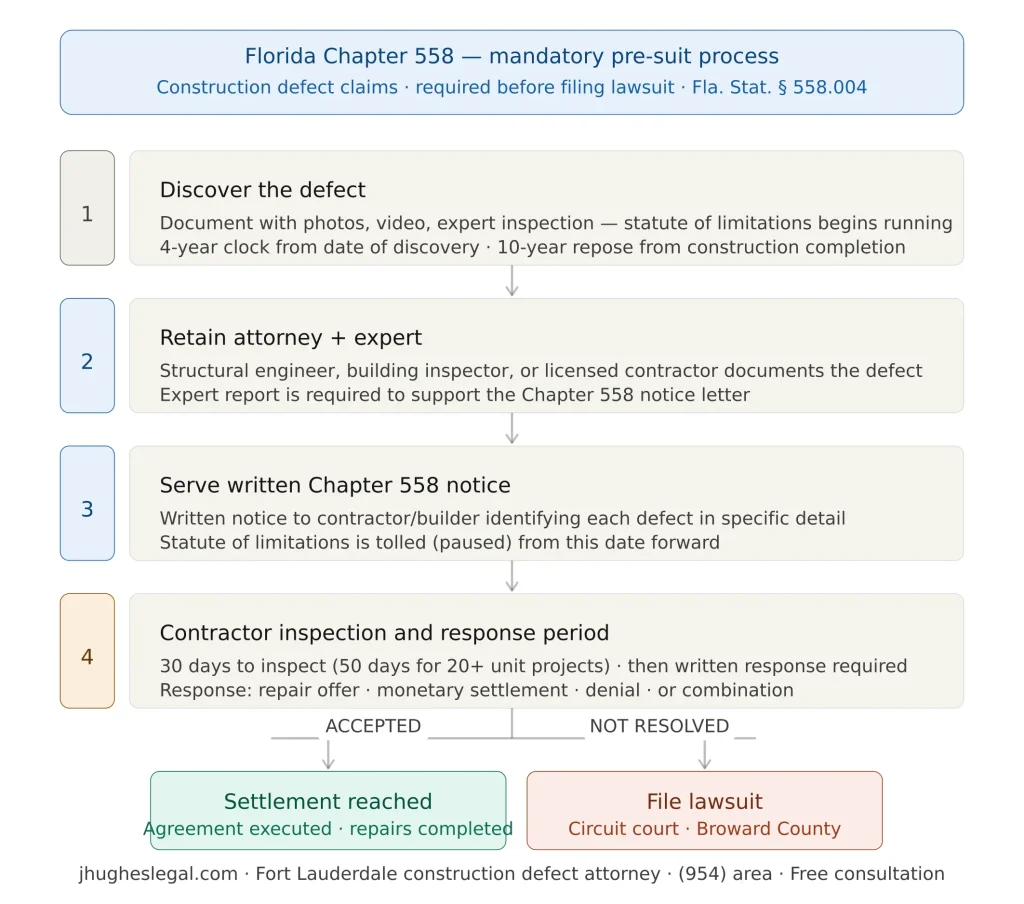
Before you can file a lawsuit over construction defects in Fort Lauderdale, Florida law requires a specific pre-suit notice procedure under Chapter 558 of the Florida Statutes. Skipping this step — even if your claim is completely valid — can result in dismissal.
What Chapter 558 Requires
- Written notice to the contractor, subcontractor, supplier, or design professional identifying each alleged defect in reasonable detail
- The contractor has 30 days to inspect the property (or 50 days for projects with more than 20 units)
- After inspection, the contractor has a set period to make a written monetary settlement offer, offer to repair, or contest the claim
- Only after the notice and response period expires can you file suit
Why This Step Matters Strategically
Chapter 558 is not merely a procedural hurdle — it’s a strategic opportunity. A well-crafted notice letter, backed by expert reports, puts the contractor on notice of specific defects with documented evidence. Contractors who receive a strong Chapter 558 notice from a Fort Lauderdale construction defect attorney frequently make settlement offers before litigation begins, saving significant time and cost for homeowners.
The Statute of Limitations Trap
Critically, the Chapter 558 notice period tolls (pauses) the statute of limitations while the process runs. But you must serve the notice before the limitations period expires. Many Fort Lauderdale homeowners lose viable construction defect claims not because the defect isn’t real but because they waited too long to consult an attorney. The 4-year limitation period from date of discovery moves faster than most people expect.
Practical Rule: As soon as you suspect a construction defect in your Fort Lauderdale home, consult an attorney — not a contractor. Talking to the contractor first without legal guidance can inadvertently restart limitation periods or waive rights.
What to Document Right Now If You Suspect a Construction Defect
If you’ve discovered what may be a construction defect in your Fort Lauderdale home, the documentation you create in the first days is often the most important evidence in your entire case. Here’s exactly what to do:
Immediate Steps
- Photograph and video everything: Take time-stamped photos and video of every visible manifestation of the defect. Get close-ups and context shots. Store copies in a cloud backup that cannot be altered.
- Don’t make permanent repairs yet: Making permanent repairs before a formal inspection by a retained expert can destroy evidence. Temporary measures to prevent further damage (tarping a leak, for example) are acceptable — but document the temporary fix thoroughly.
- Pull the permit history: Access Broward County’s building permit database and print the complete permit history for the property. Note any gaps between work visible in the home and permits in the record.
- Gather all closing documents: Your seller’s disclosure form is critical. What did the seller represent about the condition of the property? What did they explicitly deny knowing about?
- Get copies of all warranties: Builder warranties, manufacturer warranties on roofing systems, windows, or HVAC equipment may provide additional recovery paths independent of litigation.
Retain an Expert Early
Construction defect cases in Florida require expert testimony to establish causation, standard of care, and the cost to repair. Retaining a qualified building inspector, structural engineer, or licensed contractor as a litigation consultant early in the process — before Chapter 558 notice is served — gives your attorney the technical foundation needed to write a notice letter that carries weight.
Practical Rule: Your seller disclosure form is often the most powerful document in a construction defect case. A seller who checked ‘No known defects’ for water intrusion, and whose prior insurance claims reveal three water damage claims in five years, has a significant problem.
Frequently Asked Questions About Construction Defects in Fort Lauderdale
| Question | Answer |
| How long do I have to file a construction defect claim in Florida? | Generally 4 years from discovery for latent defects under Florida Statute § 95.11. The 10-year statute of repose runs from construction completion. A Fort Lauderdale construction defects attorney can assess your specific deadline. |
| Does Florida law require me to notify the contractor before suing? | Yes. Chapter 558 of the Florida Statutes requires written notice to the contractor/builder before filing a lawsuit, giving them an opportunity to inspect and respond. This step is mandatory — skipping it can jeopardize your claim. |
| What if defects appear after the builder’s warranty expires? | Florida’s implied warranty of habitability may still apply. Latent defects discovered after the express warranty period can still be actionable if within the statute of limitations from date of discovery. |
| Can I sue the previous owner, not just the builder? | Potentially yes. Florida law requires sellers to disclose known material defects. If the prior owner concealed construction defects, a real estate fraud claim may lie in addition to or instead of a construction defect claim. |
| What if the work was done without a permit? | Unpermitted work creates significant liability. Under Florida Statute § 489.126, contractors must pull required permits. Unpermitted work discovered post-closing gives grounds for claims against both the contractor and potentially the seller who failed to disclose it. |
| Do I need a lawyer or can I handle this myself? | Construction defect claims in Florida involve strict procedural requirements under Chapter 558, expert testimony standards, and aggressive insurance defense. Representation by an experienced Fort Lauderdale construction defects attorney is strongly recommended. |
When to Call a Fort Lauderdale Construction Defect Attorney
Construction defects don’t get better on their own. Water intrusion grows into mold. Foundation movement accelerates. Electrical faults become fire risks. And Florida’s limitations clock runs whether you act or not. If you’ve purchased a Fort Lauderdale home and discovered problems that look like they were there before you moved in — defects in the roof, foundation, electrical, HVAC, or unpermitted work — you need legal guidance before you talk to the contractor, the seller, or their insurance company.
At Hughes Real Estate Law, we represent Fort Lauderdale homeowners in construction defect claims, real estate disputes, and all matters arising from property transactions throughout Broward County. Contact us today for a consultation about your situation.
About Joseph Hughes
Joseph Hughes is a Fort Lauderdale real estate attorney and the founder of Hughes Real Estate Law, a Broward County firm focused exclusively on real estate transactions, litigation, and disputes. Joseph represents homeowners, investors, landlords, tenants, buyers, and sellers across Fort Lauderdale, Hollywood, Davie, Margate, Sunrise, and the surrounding Broward County communities.
Joseph’s practice covers the full spectrum of real estate legal matters: construction defect claims, real estate fraud, contract disputes, closings, foreclosure defense, landlord-tenant law, HOA and condo association representation, lien removal, title issues, and quiet title actions. He is licensed by the Florida Bar and brings a thorough, direct approach to every client matter — focusing on clear legal strategy, honest assessment of risks and outcomes, and efficient resolution whether through negotiation, Chapter 558 pre-suit proceedings, or litigation.
When Fort Lauderdale homeowners discover construction defects after closing — water intrusion, foundation problems, unpermitted work, or electrical failures — Joseph Hughes provides the legal guidance needed to identify responsible parties, preserve evidence, meet Florida’s strict pre-suit notice requirements, and pursue maximum recovery under Florida law.
Schedule a consultation with Joseph Hughes · jhugheslegal.com · Fort Lauderdale, Florida
